ZooCELL Doctoral Network
ZooCELL is a Marie Sklodowska-Curie Doctoral Network that will train 12 doctoral candidates in a new field of comparative integrative cell biology in animals. The network brings together 8 beneficiaries and 7 associated partners, located in 6 different countries (France, Germany, Italy, Netherlands, Sweden and UK) and one intergovernmental organisation (EMBL-ZooCELL coordinator).
12 Doctoral candidates will enjoy a multi-disciplinary and international environment with plenty of training opportunities and exchange with all labs involved in the Network.
Curious about the ZooCELL Scientific Vision?
ZooCELL brings together leading researchers across Europe to explore how cellular diversity emerges and evolves, shaping the complexity of animal life.
Click here to learn more about our project and watch our introductory video.
Meet the ZooCELL Doctoral Candidates
Through a series of videos, you will get to know the ZooCELL doctoral candidates and learn about their research projects.
Events
Follow us on

Mastodon:
@ZooCELL

Bluesky:
@zoocell.bsky.social
Pixelfed:
pixelfed.social/ZooCELL
Youtube:
@ZooCELL_MSCA_DN
You’ve got questions? Ask a Scientist!
News

Modern techniques in an ancient city: 2nd ZooCELL practical course at SZN in Naples.
By Kevin Gruener, Doctoral Candidate, CNRS-IGFL. When Anton Dohrn founded the first zoological marine station of the world in Naples, he wanted to offer a space for scientists from all around the world to conduct their research. His vision lives on 150 years later,…
More News:
🌐 🧳 Secondments🧳 🌐
A key highlight of the ZooCELL journey is the opportunity for our doctoral candidates (DCs) to take part in secondments across the network. During these periods, they temporarily relocate to partner institutions, where they gain hands-on training, learn new…
Training at the roots of evo-devo: 1st ZooCELL graduate school report
Jena has long been a place where science, curiosity, and creativity meet. At the venerable Friedrich-Schiller-Universität Jena (FSU Jena), the institution where the 19th century biologist Ernst Haeckel studied and later taught, twelve enthusiastic graduate students gathered from 15th to 17th September 2025 for the first ZooCELL Graduate School.
Practical course on Animal Diversity and EM sample preparation
By Asli Kilic, Doctoral candidate, Arendt lab-EMBL. The very first ZooCELL practical course took place at the Centre of Organismal Studies (COS) in Heidelberg, Germany, from February 3rd to 14th, 2025. This hands-on course on “Animal Diversity and EM Sample…
ZooCELL Project Launches with Vibrant Kickoff Meeting
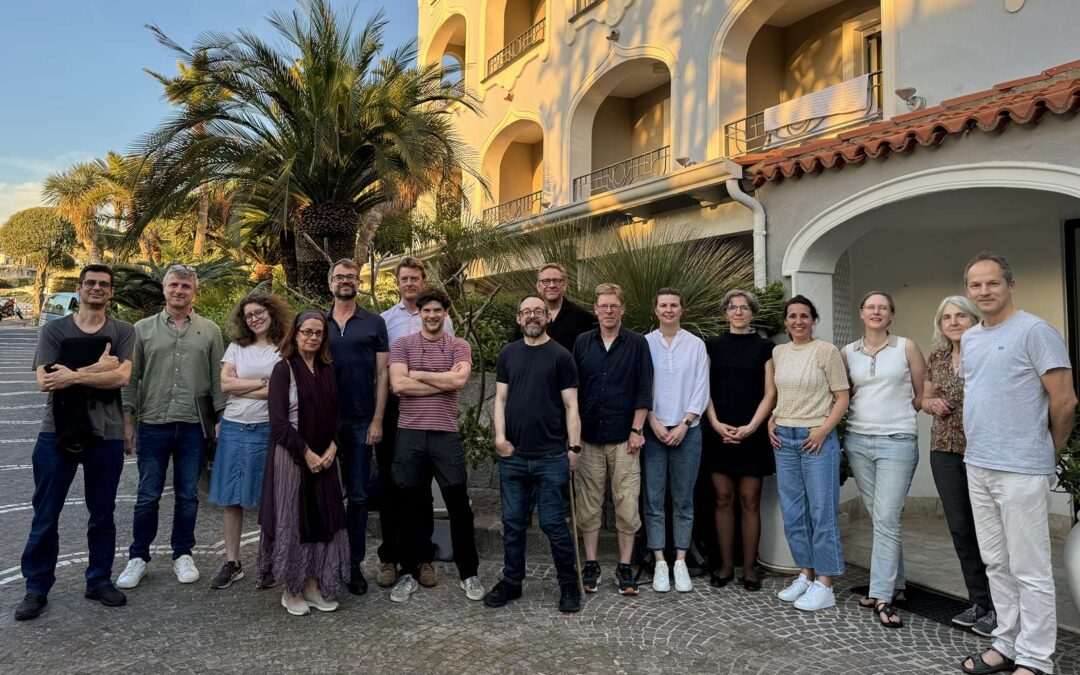
The inaugural ZooCELL kick-off meeting convened in the scenic setting of Ischia, Italy, from April 12th to 14th, 2024. This in-person gathering brought together ZooCELL’s Principal Investigators for a series of engaging sessions and discussions. The meeting started…
About us:
🔬 Meet Kevin Grüner, Doctoral Candidate in the ZooCELL team at IGFL!
Kevin completed a BSc in Biology and a MSc in Zoology at the University of Innsbruck, where he also worked at the electron microscopy facility and tutored courses in zoology, developmental biology, and image analysis.
Now, as part of ZooCELL, he is investigating how the crustacean Parhyale hawaiensis regenerates its limbs, one cell at a time.
🧵 Read on to get to know Kevin.
🔬 Meet Mathilde Paris, PI and co-leader of the ZooCELL team at IGFL!
In this thread, Mathilde shares what first drew her to EvoDevo, the questions that drive her research, and what she enjoys most about mentoring the next generation of scientists.
🧵👇 1️⃣ What first drew you to EvoDevo?
🔬 Meet Michalis Averof, ZooCELL PI at IGFL
What sparked his interest in EvoDevo? What keeps him curious after all these years? And what does he hope to discover next?
🧵 Read on to get to know Michalis through his own words.
🇫🇷 Meet our partner, the Institut de Génomique Fonctionnelle de Lyon (IGFL)
The IGFL is an institute of the ENS de Lyon, the CNRS and Université Lyon. It brings together 12 research teams focusing on the interfaces of development, physiology and evolution. The IGFL is home to the Development, Regeneration and Evolution team, led by Michalis…
The ZooCELL Scientific Vision
ZooCELL brings together leading researchers across Europe to explore how cellular diversity emerges and evolves, shaping the complexity of animal life.
All animals need to sense their environments. The ability to detect light, temperature, chemicals, sound, vibrations and other stimuli depends on an extraordinary range of sensory cell types. The diversity and relationships between these receptor cells across the animal phyla, how they have been adapted, reused, tweaked and sometimes lost, is little known but is crucial for understanding how animals survive and thrive in diverse environments. Most sensory cells are characterised by complex shapes and molecular machinery, first discovered by meticulous electron microscopy in the past decades. More recently, this has been complemented by genetic studies of their development and differentiation in various animal models.
These two research programmes have, however, largely remained separate, and a unified morphological and molecular understanding of how the diversity of animal sensory cells has evolved is lacking. Our aim in ZooCELL is to create a comprehensive view of sensory cell type evolution based on the discovery of recurrent patterns of genetic and subcellular structure across a wide range of new animal models. To this end, we will combine single-cell genomics, correlative light and electron microscopy,
Artificial Intelligence, and reverse genetics approaches in these species. ZooCELL will bring together Europe’s world-leading expertise in these disciplines, and thus contribute to building the field of comparative integrative cell biology in animals. While training the next generation of doctoral students in these novel interdisciplinary techniques, we will develop new tools for combined molecular and morphological comparative analyses of cell types. Our interdisciplinary, intersectoral and international training programme will also include dissemination and public outreach, and the comprehensive training provided will enable our graduate students to assume leadership roles in academia, industry and science outreach.
Find more videos on our Youtube channel (@ZooCELL_MSCA_DN) or on our Pixelfed profile (@pixelfed.social/ZooCELL).